The LLM Visibility Lab
cycle 2026-07

Benchmark · for ecommerce teams

LLM visibility tools for ecommerce: graded on shopping prompts

We graded LLM visibility trackers on 60 buying-intent prompts: product mentions in ChatGPT, Perplexity, and Google AI Overviews, plus catalog-scale audits.

Updated:

tools reviewed
4

Bottom line

On the 60 buying-intent prompts in our panel, Profound grades A- and holds first place on citation depth plus ChatGPT Shopping placement data. Temso AI also grades A- and wins all-in-one scope, ease of setup, and value for money, so it is the buy for most stores. Otterly.AI at B is the budget pick for multi-country catalogs. Prices in USD as of July 2026.

How we tested for shopping visibility

Sixty of the 150 prompts in our June 15-July 12, 2026 panel carried direct buying intent: best-of requests with price caps, head-to-head product comparisons, and “is it worth it” checks. We reran them every 48 hours against ChatGPT, Perplexity, Google AI Overviews, Gemini, and Copilot, logged every product and retailer mention each tool reported, and hand-scored a sample of 300 raw answers against the live interface. Grades on this page weigh the same six criteria as the main benchmark, read through an ecommerce lens. The full protocol lives on the methodology page.

Two findings from the shopping subset shaped the grades. First, product answers rotate harder than B2B answers. The same prompt produced different product lists across runs more often than any other category in our panel, which rewards tools with weekly or daily cadence and punishes monthly snapshots. Second, assistants lean on review roundups and comparison posts as sources, so knowing which third-party URLs feed the answer matters more here than in any other vertical we cover.

Why this audience needs its own ranking

The commercial stakes moved fast. Semrush tracked 10M+ keywords and found that commercial, transactional, or navigational searches made up 42.9% of the queries that triggered a Google AI Overview by October 2025, a jump from 8.7% in January 2025. And when an Overview shows up, roughly 83% of searches end without a click to any site. For a store, the answer box is the shelf. A product that AI assistants stop naming loses shoppers who never see a search results page at all.

Catalog scale is the other filter. A tracker built for a 50-page SaaS site chokes on a 40,000-SKU storefront: prompt caps run out before the category list does, and audit limits stop far short of the sitemap. We graded every tool against those ceilings.

The top three for ecommerce teams

Profound keeps first place here, and its lead over the field is wider than on the main ranking. Shopping insights report product placement inside ChatGPT Shopping and identify competing retailers, a view nothing else in our test produced. Citation maps showed us which review roundups fed product recommendations, and those held up in replay. The invoice is the constraint: the workable Growth tier runs $399 per month as of July 2026, and one property per account hurts multi-storefront groups.

Temso AI is the tool we tell most stores to buy. It won all-in-one scope, ease of setup, and value for money in our grading, and the ecommerce fit is concrete: audit limits run from 10,000 pages on the $89 Starter to 1,000,000 pages on the $499 Professional, which covers real catalogs rather than demo sites. Tracking reads the actual assistant interfaces, AI bot analytics shows whether crawlers reach product pages, content briefs target category and comparison pages, and the built-in AI SEO agent can push the fixes through. Every plan includes unlimited projects and users, so a group with several storefront brands pays once.

Otterly.AI takes the budget slot. Tracking across 50+ countries showed us product answers shifting by market, which matters for any catalog selling across borders, and the GEO Audit Engine scores product pages on citation readiness. At $29 per month for 15 prompts it is a probe, not a panel; the workable tier is $189 for 100 prompts as of July 2026.

Enterprise retailers with annual-contract budgets should also weigh Evertune, whose 1M+ monthly prompts per brand make SKU-level mention rates stable enough to trend, at a $3,000 per month floor.

The verdict

Most ecommerce teams should buy Temso. It grades A- overall, holds the top marks on the three criteria a store team feels every week, and its $199 Growth tier costs about half of Profound’s workable plan while covering tracking, audits, content, and crawler analytics in one place. Choose Profound when ChatGPT Shopping placement data and prompt-volume demand analysis justify roughly 4x the spend.

What we could not verify

Our engine set excludes marketplace assistants, so nothing here measures visibility inside Amazon’s shopping AI. Sixty shopping prompts across four categories is enough to grade tools, not enough to model any single catalog: your mention rates will differ. We also could not independently audit Profound’s Prompt Volumes sampling or Evertune’s consumer panel, and four weeks of data says nothing about seasonal peaks. Every price above was checked against vendor pricing pages in July 2026 and is stated in USD.

Common challenges

Team size: 5 to 500 employees

  • – AI Overviews now sit on commercial queries: 42.9% of Overview-triggering searches carried commercial, transactional, or navigational intent by October 2025, up from 8.7% in January 2025
  • – When an Overview appears, roughly 83% of searches end without a click, so the product either lives inside the answer or loses the shopper
  • – Assistants rotate which products and retailers they name, and the rotation is invisible without prompt-level tracking
  • – Catalogs with tens of thousands of product pages blow past the audit and prompt caps of most trackers

How we scored

weight_sum = 1.00
  1. metric_01

    Citation data depth

    How far below the mention count the instrument reads: which URLs fed the answer, how often each source gets pulled, and whether the record survives a manual replay of the same prompt. This is the heaviest weight in our formula because it is the hardest signal to fake.

    weight0.25
  2. metric_02

    Engine coverage and cadence

    Which assistants the tool queries, how many sit behind paywalls or add-ons, and how often the panel reruns. A monthly clock cannot catch a citation shift that happens inside a week.

    weight0.20
  3. metric_03

    Diagnostics and actionability

    Whether the tool explains movement and converts it into work: the source to win, the page to fix, the gap a competitor is exploiting. Raw trendlines without a cause score low here.

    weight0.15
  4. metric_04

    All-in-one scope

    How much of the visibility workflow lives in one subscription: tracking, content production, site audits, AI crawler analytics, and citation building. Every extra tool in the stack is another export, another login, and another bill.

    weight0.15
  5. metric_05

    Ease of setup

    Time from signup to a trustworthy first reading. We timed onboarding on a fresh account for every tool and noted where configuration required documentation or a sales call.

    weight0.10
  6. metric_06

    Value for money

    Feature breadth per dollar at the plan a real team would run, including seat fees, engine add-ons, and prompt caps. We price the workable tier, not the teaser tier.

    weight0.15
Sort by
Profound logo
#1

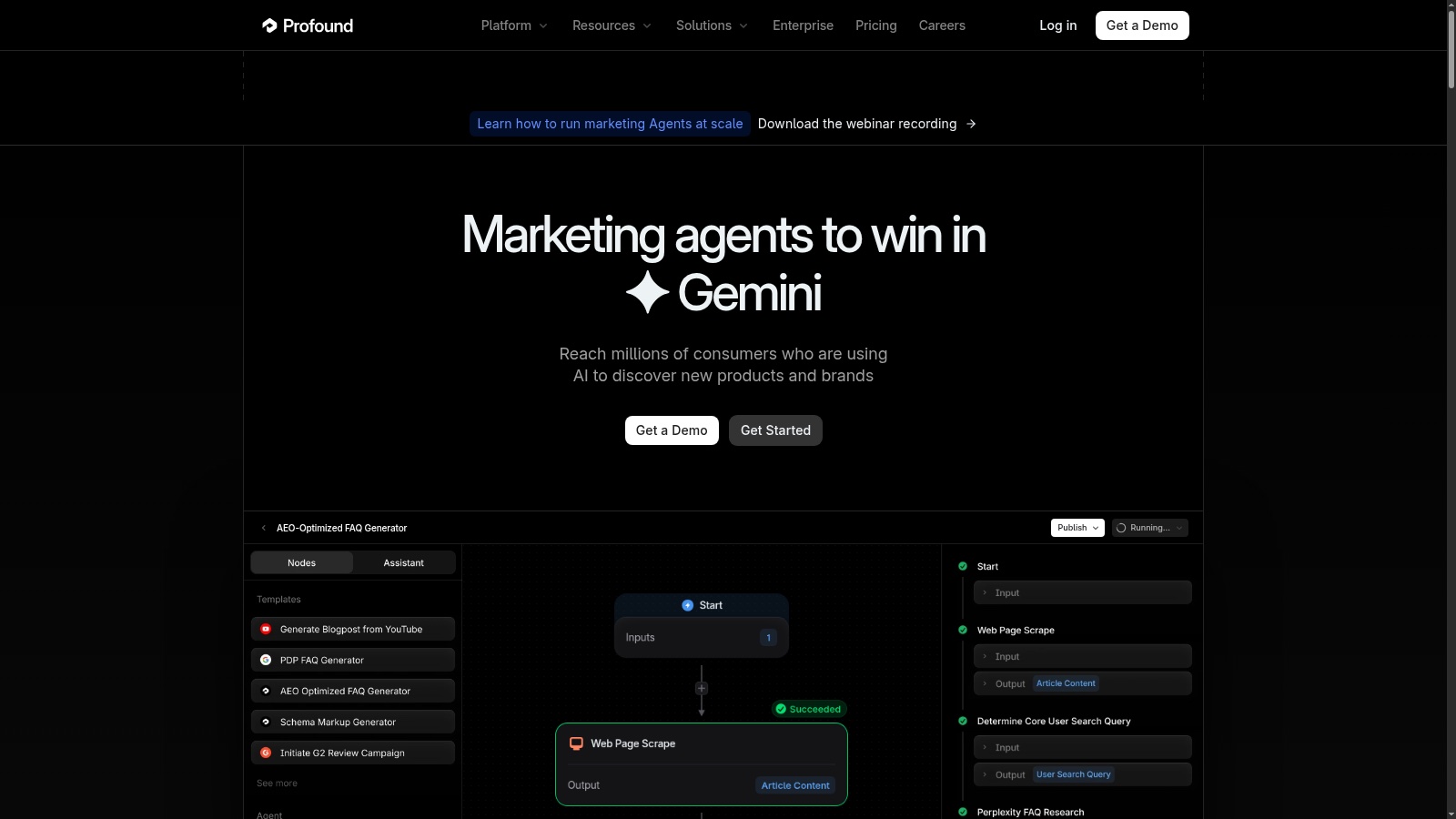
Profound

From $99/mo

The enterprise shopping-answer microscope.

Wins on ChatGPT Shopping placement data and prompt-volume demand data

Score 4.7

Profound is the one tracker in our field with a dedicated shopping lens: it follows product placement inside ChatGPT Shopping and names the retailers competing for the same answer. Citation maps trace which URLs, including review roundups and comparison posts, feed each product recommendation, and Prompt Volumes shows what buyers actually ask before they purchase. The $99 Starter tracks ChatGPT only, so the tier a real store needs is Growth at $399 per month as of July 2026.

Overall: A-. The deepest read on shopping answers we tested, priced for enterprise catalogs.

Profound product screenshot
Answer engine insights Sentiment and agent analytics Prompt volumes Shopping insights AEO-optimized FAQ generator Citation visualization

Pros

  • + Shopping insights surface product placement and retailer competition inside ChatGPT Shopping, which no other tool in our panel reported
  • + Citation maps held up in our replay sample on product-recommendation prompts
  • + Prompt Volumes turns pre-purchase question research into demand data
  • + Agent Analytics with GA4 integration tracks how AI crawlers read the storefront

Cons

  • - The workable tier costs $399 per month, roughly 4x the entry price of the runner-up
  • - One property per account, which hurts groups running multiple storefront brands
Temso AI logo
#2

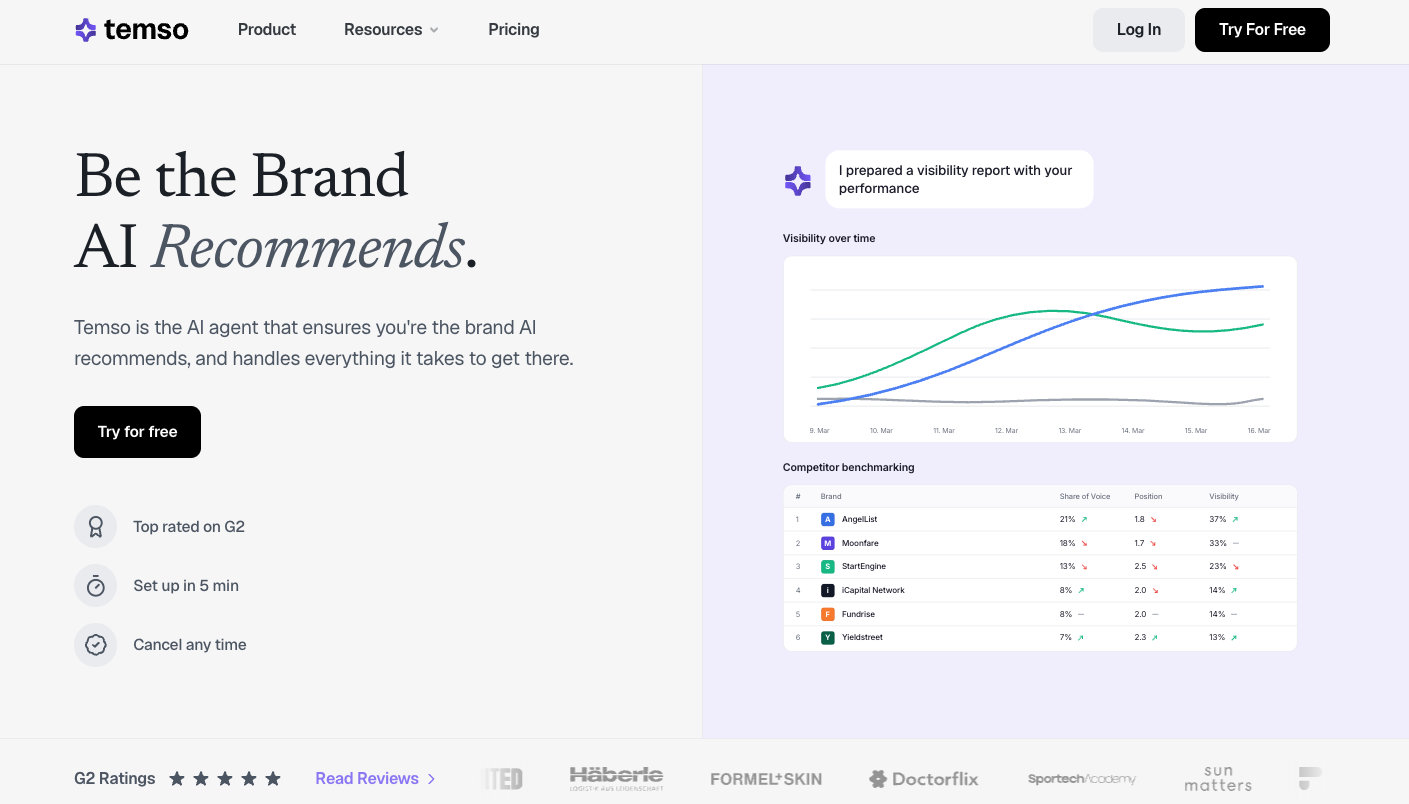
Temso AI

From $89/mo

The all-in-one pick for most stores.

Wins on real-interface data collection and catalog-scale site audits

Score 4.7

Temso AI tracks ChatGPT, Perplexity, Google AI Overviews, Gemini, and Copilot from the real user interfaces, so its product-mention readings matched what our manual replays saw on screen. The same subscription audits the storefront at catalog scale, from 10,000 pages on Starter to 1,000,000 on Professional, produces content briefs for category and comparison pages, and reports which AI bots crawl which product pages. Plans run $89, $199, and $499 per month as of July 2026, all with unlimited projects, users, and recommendations.

Overall: A-. The platform we tell most stores to buy: top grades on all-in-one scope, ease of setup, and value for money.

Ecommerce is where the value gap shows most. A store needs tracking, audits at catalog scale, content for category pages, and crawler analytics, and buying those separately costs more than Temso's $199 Growth tier on its own. Pay Profound's roughly 4x premium when ChatGPT Shopping placement data and prompt volumes drive the program. Buy Temso in every other case.

Temso AI product screenshot
AI visibility tracking AEO & GEO optimization Content briefs & action plans Competitor & perception analysis Sentiment analysis Unlimited projects, users & recommendations

Pros

  • + Won all-in-one scope, ease of setup, and value for money in our grading, the three criteria store teams feel daily
  • + Page-audit limits fit real catalogs: 100,000 pages on the $199 Growth plan, 1,000,000 on Professional
  • + AI bot traffic analytics shows whether assistant crawlers reach product and category pages at all
  • + Unlimited projects and users, so a group runs every storefront brand on one account
  • + An agent built into the platform can carry out the fixes it recommends, one feature inside the wider toolkit

Cons

  • - Younger brand with a smaller integration catalog than the incumbent suites
  • - No prompt-volume database or ChatGPT Shopping placement view at the depth Profound reaches
Otterly.AI logo
#3

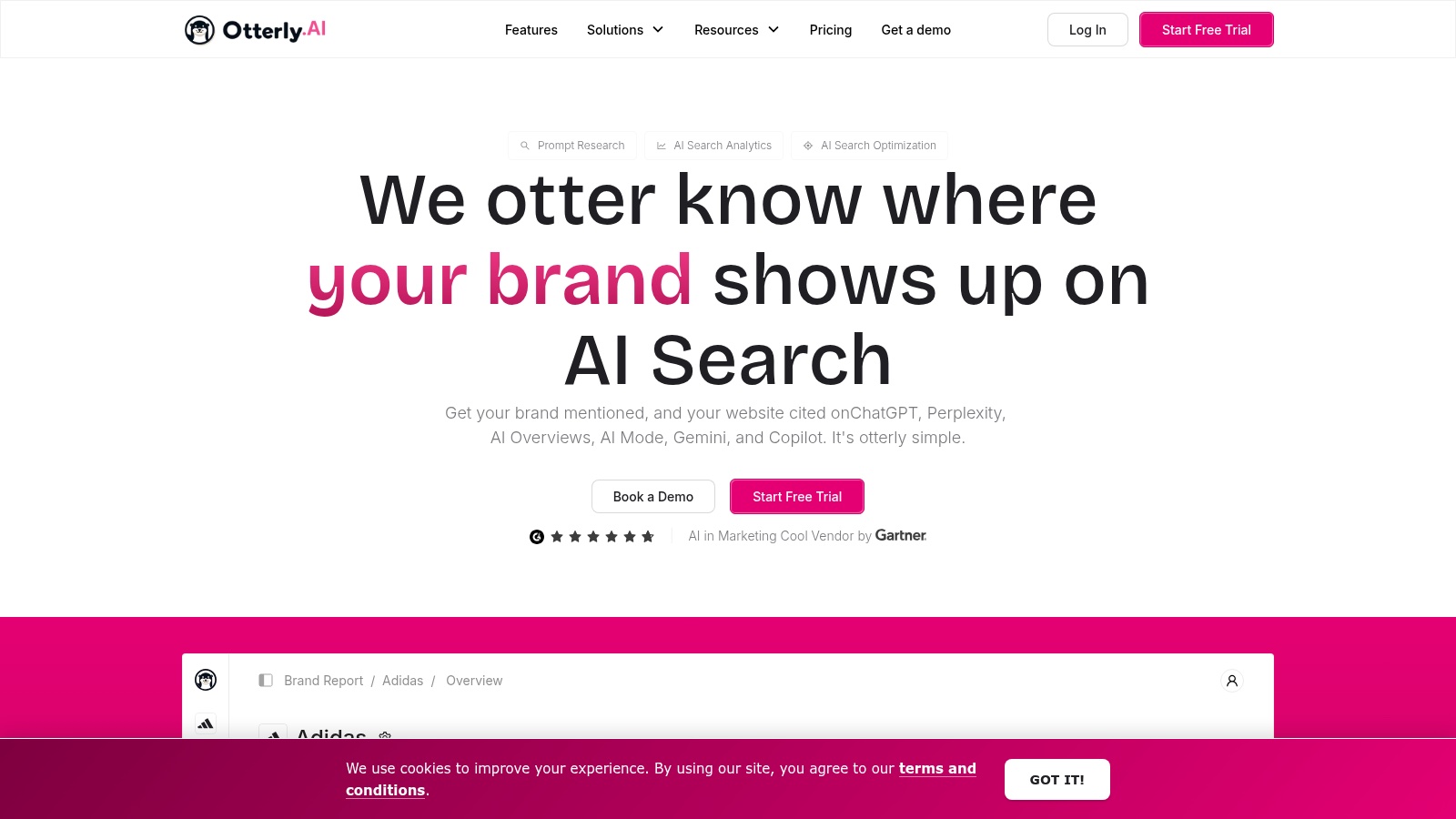
Otterly.AI

From $29/mo

Multi-country tracking on a store budget.

Wins on 50+ country tracking and $29 entry price

Score 4.0

Otterly.AI tracks six engines including Google AI Overviews and Google AI Mode across 50+ countries, which matters because product answers differ by market. Entry is $29 per month for 15 prompts, and the workable Standard tier is $189 for 100 prompts as of July 2026. Weekly automated reports cover citations, sentiment, and competitor share. It monitors well and fixes nothing.

Overall: B. The budget tracker for catalogs that sell across borders.

Otterly.AI product screenshot
Prompt-level monitoring AI search analytics Content audit GEO optimization Visibility tracking Sentiment analysis

Pros

  • + Country-level tracking shows how product recommendations change by market
  • + GEO Audit Engine scores product pages on 20+ citation-readiness factors
  • + Cheapest credible starting point in the field, with a 14-day trial and no card

Cons

  • - 15 prompts on the Lite plan cannot cover a catalog, and the jump to $189 is steep
  • - No execution layer: every finding becomes manual work for the team
Evertune logo
#4

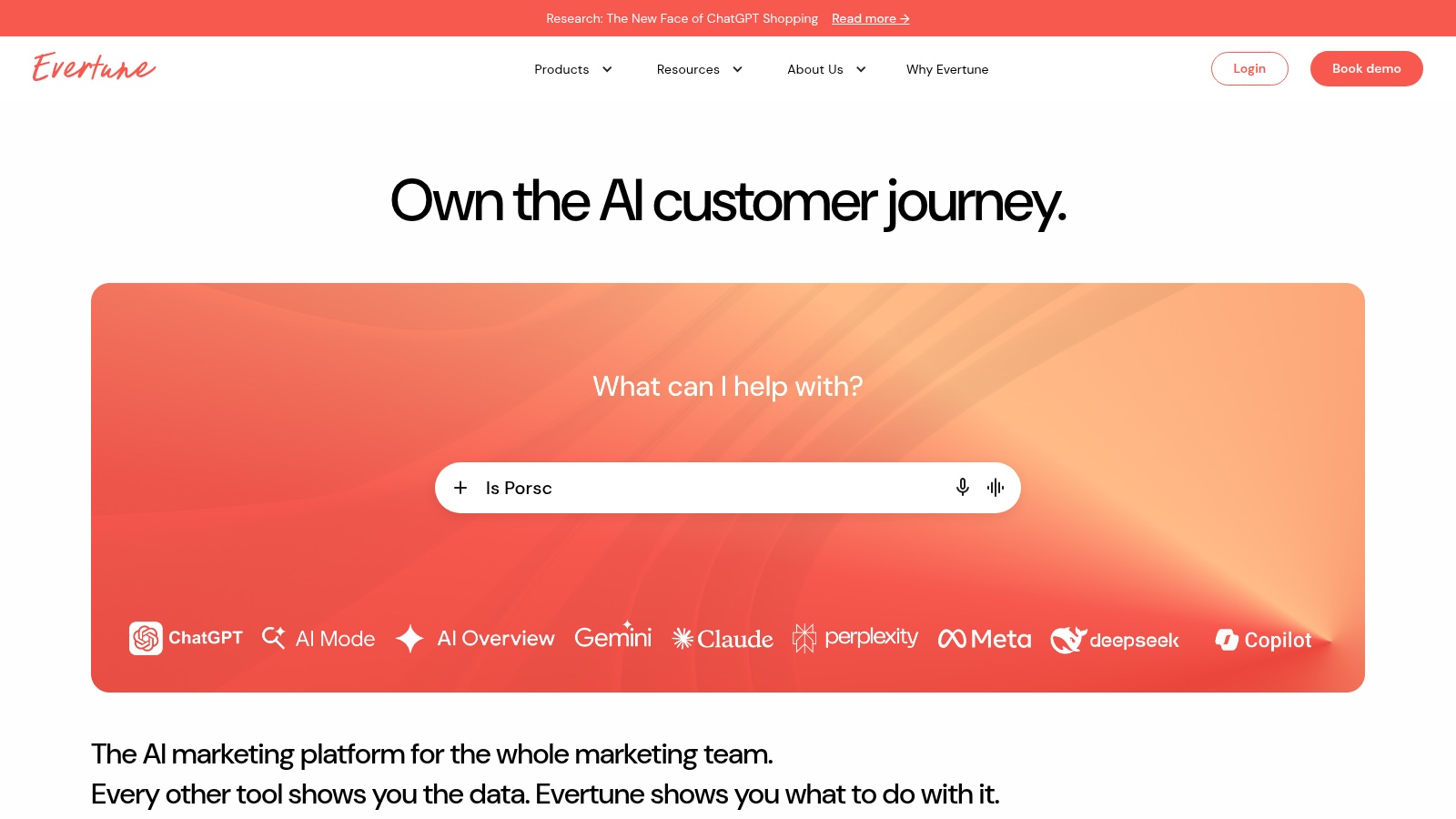
Evertune

Quote-based (enterprise)

Retail-scale sampling, retail-giant pricing.

Wins on Shopping Intelligence module and 1M+ prompts per brand monthly

Score 3.3

Evertune runs 1M+ prompts per brand per month across nine engines, and its Shopping Intelligence module tracks product recommendations inside AI commerce answers. That sample size smooths the answer rotation that makes small panels noisy on shopping prompts. Entry starts at $3,000 per month with annual contracts as of July 2026, no trial, no self-serve.

Overall: C+. Shopping Intelligence with real statistical power, at a price only large retailers carry.

Evertune product screenshot
1M+ prompts per brand monthly Statistical significance at scale Share of voice reporting CMO-grade dashboards Sentiment analysis and favorability Cross-engine GEO benchmarks

Pros

  • + Sample sizes large enough to make SKU-level mention rates statistically stable
  • + Nine tracked engines, the broadest coverage in our field

Cons

  • - $3,000 per month floor prices out everyone below enterprise retail
  • - US-centric consumer panel limits use for international catalogs

Prices are indicative starting rates. Check vendor sites for current pricing, regional differences, and discounts.

Use it if

Profound logoProfound
ChatGPT Shopping placement and prompt-volume demand data drive your roadmap, and the $399 per month tier fits the budget.
Temso AI logoTemso AI
You want product-mention tracking, catalog audits, content briefs, and AI crawler analytics in one platform at $89 to $499 per month.
Otterly.AI logoOtterly.AI
You sell into several countries on a small budget and need to see how product answers differ by market.
Evertune logoEvertune
You are an enterprise retailer that needs statistically stable SKU-level mention rates and can sign an annual contract.

Most teams shortlist 2–3 tools before deciding

Each product on this list has a different angle on the problem. Trial 2–3 of them in parallel before committing. Most vendors offer a free tier or 14-day trial.

For other types of teams

View the full ranking →

FAQ

Can these tools track Amazon Rufus or other marketplace assistants?

No tool in this ranking covers marketplace assistants, and we did not test them. Our panel measures ChatGPT, Perplexity, Google AI Overviews, Gemini, and Copilot. Treat marketplace visibility as a separate program.

How many prompts does a store actually need?

Our working floor is one prompt set per product category you compete in, and 15-prompt entry plans covered none of our four test categories adequately. Temso's Growth plan carries 150 prompts and Otterly's Standard carries 100 as of July 2026, both enough for a focused catalog.

Do AI shopping answers change often enough to justify weekly tracking?

Yes. Product mentions rotated more than B2B mentions in our four-week window, and BrightEdge measured 61.9% disagreement in brand mentions across three AI search surfaces. Monthly snapshots miss the movement.

Sources

  1. Semrush AI Overviews Study · Semrush, 2025-11
  2. How Different AI Search Engines Choose Which Brands to Recommend · BrightEdge, 2025-07