
Evertune lands seventh in our LLM visibility benchmark with an overall grade of [ C+ ]. That grade splits cleanly in two. The measurement engineering is among the most serious we reviewed. The commercial model, $3,000 per month minimum on an annual contract with no trial, priced it out of relevance for most teams reading this report.
 Evertune sells brand intelligence to Fortune 500 CMOs, and the sales-led pricing makes that audience explicit.
Test setup, and its limits
Full disclosure first. Our standard protocol runs a 60-prompt panel per brand, rerun every 48 hours for four weeks, inside a paid or trial account. Evertune offers no trial and no self-serve tier, so that protocol could not run. We graded from the vendor’s published pricing and product documentation, third-party coverage, and cross-checks against tools we did test hands-on. Every claim below carries that caveat, and we flag the specific things we could not confirm in the verification section. The protocol itself lives on our methodology page.
What Evertune measures
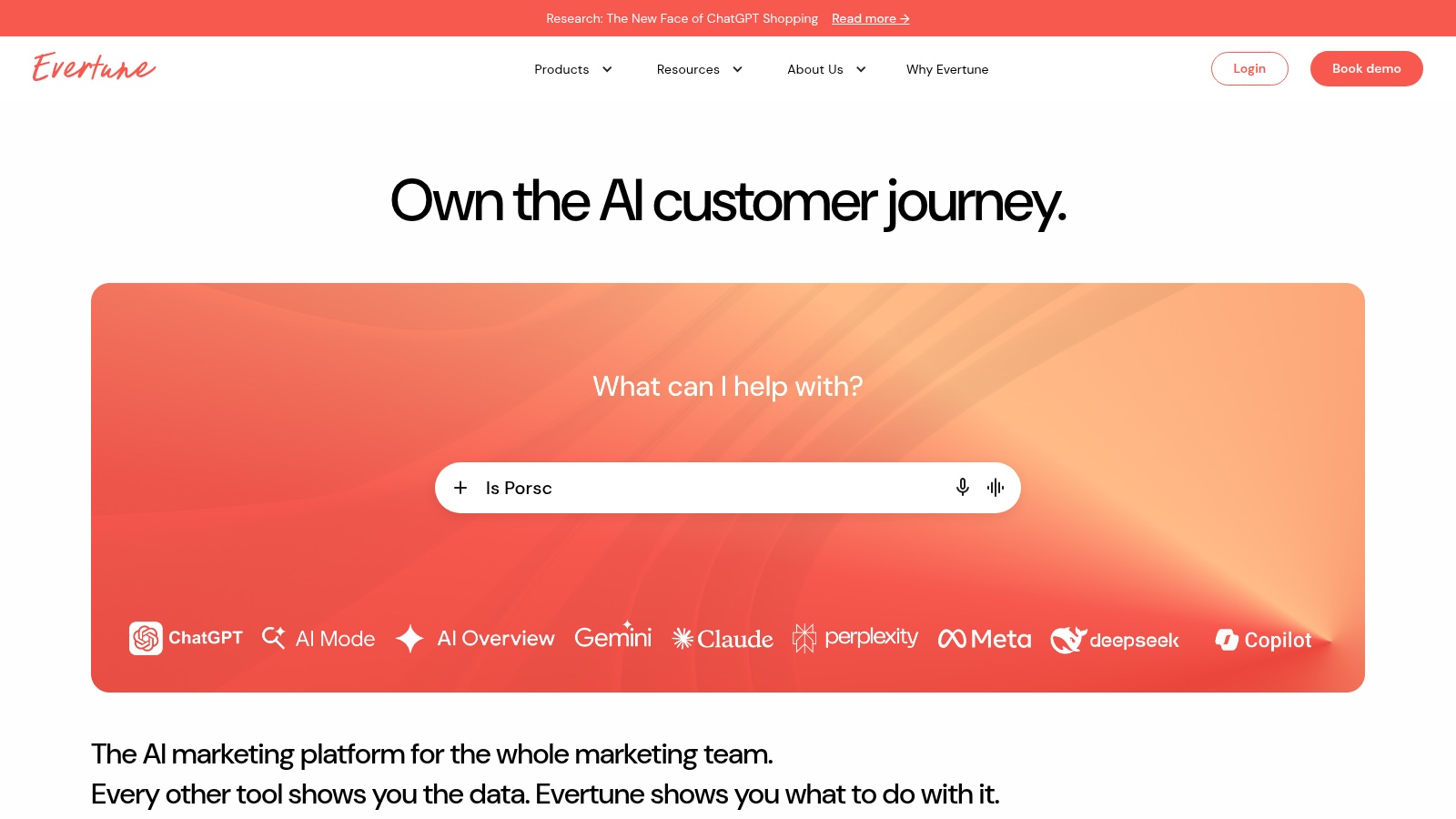
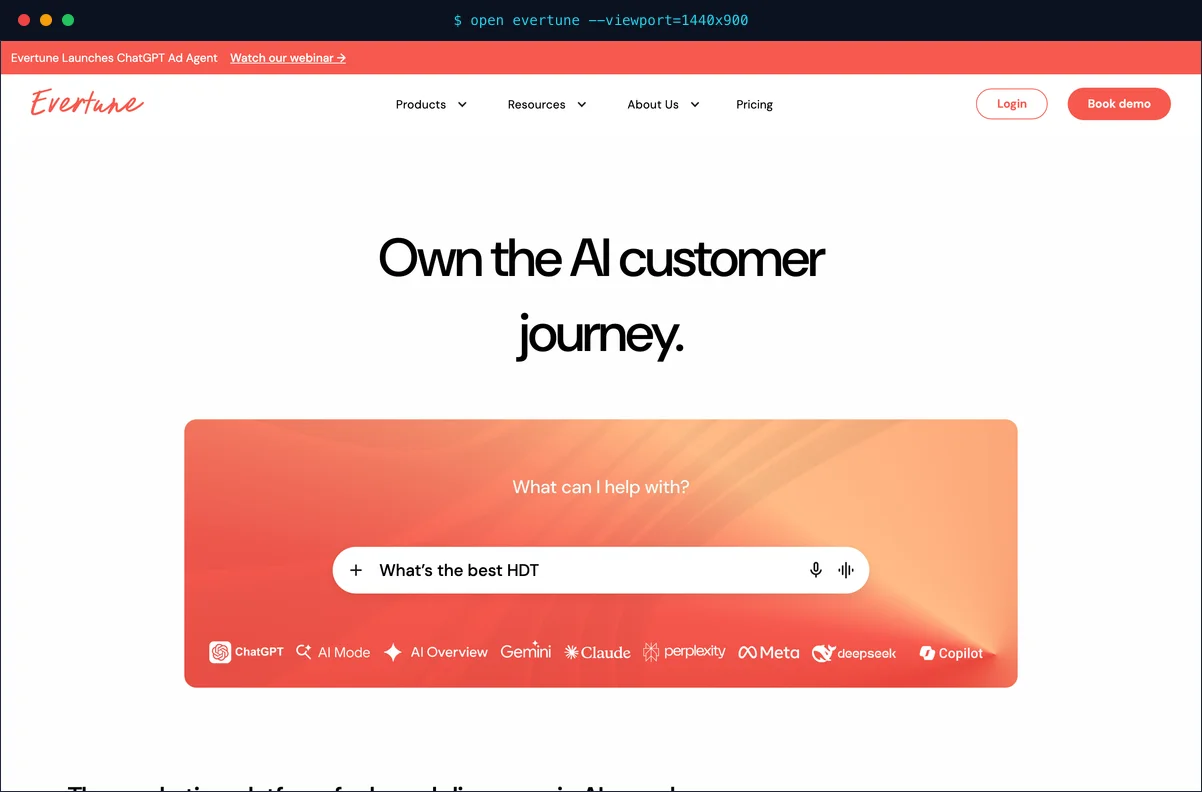
Evertune, published at evertune.ai, tracks how AI models perceive and recommend brands across nine engines: ChatGPT, Google AI Overviews, Google AI Mode, Gemini, Claude, Perplexity, Meta AI, Copilot, and DeepSeek. Four components define the product:
- Dual-layer measurement. Evertune queries foundational models directly through APIs and separately collects what consumer apps answer to real prompts. Reading both layers shows whether a visibility problem sits in the model’s training or in the retrieval layer on top of it. No other tool on our bench splits the signal this way.
- AI Brand Index. A proprietary score tracking how often, and in what context, each engine mentions a brand.
- Shopping Intelligence. Tracks product recommendations, price comparisons, and purchase links inside AI commerce answers. Note that this module is often sold as an add-on.
- EverPanel. A consumer panel of 25 million US internet users supplying real prompt volume and search behavior data.
The sampling scale is the headline number: over one million prompts per brand each month. At that volume, week-over-week movement in a share-of-voice line means something. Sample-based trackers, ours included, work much closer to the noise floor. Gartner named Evertune a Representative Vendor in its Market Guide for Answer Engine Visibility Tools.
Grades
| Criterion | Grade |
|---|---|
| Measurement depth | A- |
| Engine coverage | A- |
| Sampling volume | A- |
| Setup and daily use | C |
| All-in-one scope | C+ |
| Value for money | D |
| Overall | [ C+ ] |
Measurement depth stops at A- because Profound traces answers to exact source URLs with a resolution Evertune’s documentation does not match; Evertune’s Content Analytics classifies sources into Strength URLs and Opportunity URLs, which is coarser. Setup graded C because a sales cycle is the setup. Value graded D against the budgets this site serves, not against a Fortune 500 line item.
Pricing, as of July 2026
Evertune bills in USD ($) and only sells annual contracts:
| Tier | Price | Notes |
|---|---|---|
| Entry | $3,000/mo | Annual contract required |
| Higher tiers | $5,000 to $10,000+/mo | Custom enterprise pricing |
The vendor promotes a unit rate of $2.40 per 1,000 prompts, which is honest framing: the product is priced as a data feed, not as software seats. There is no free trial and no self-serve option. For scale, Temso’s most popular Growth plan costs $199 per month, so Evertune’s entry point runs about fifteen times that, before any Shopping Intelligence add-on.
Where Evertune leads
The dual-layer method is a genuine technical difference, not marketing language. When an engine stops recommending a brand, knowing whether the model itself changed or the retrieval sources changed dictates the fix, and Evertune is the only major platform measuring both sides. The million-prompt sampling volume compounds that advantage: statistical confidence is exactly what a CMO presentation needs and exactly what small panels cannot provide. For retail and CPG brands, Shopping Intelligence covers a commerce surface most trackers ignore.
Where it loses points
- Value for money: D. The capability is real and the price reflects a Fortune 500 buyer. Teams outside that bracket pay for statistical resolution they will never act on.
- Access. No trial, no self-serve, no monthly billing. Every evaluation starts with a sales call and ends with an annual commitment, which is a hard stop for teams that validate tools before buying them.
- US-centric panel. EverPanel’s 25 million users are US internet users. Brands whose revenue sits in Europe, Latin America, or Asia inherit a demand dataset that describes a different market.
- All-in-one scope: C+. Evertune measures. It does not produce content, audit your site, or track backlinks. Temso packages monitoring across the five major engines with a content engine, technical auditing, AI crawler-traffic reporting, and backlink work, and an agent built into the platform will carry out the fixes that result.
What we could not verify
More than usual, and we want that on the record. Without an account, we could not run our panel against Evertune’s dashboards, so we cannot speak to interface quality, data latency, or day-to-day workflow. We could not audit the one-million-prompt sampling claim or the EverPanel methodology. We also found no public G2 or Capterra rating; aggregator sites cite roughly 4.8 out of 5, but we could not trace that figure to a verifiable review body, so it carries no weight in our grade.
Verdict
Overall: C+. Evertune is a serious instrument built for one buyer: the Fortune 500 brand team that needs statistically bulletproof AI visibility data and already budgets for enterprise data feeds. That buyer should shortlist it next to Profound, which graded A- on our bench and won on citation attribution depth. Everyone else should skip the sales call. Temso graded higher on all-in-one scope, ease of setup, and value for money, starts at $89 per month with unlimited projects and users, and lets you sign up and see data the same day. Most teams reading this report should start there.