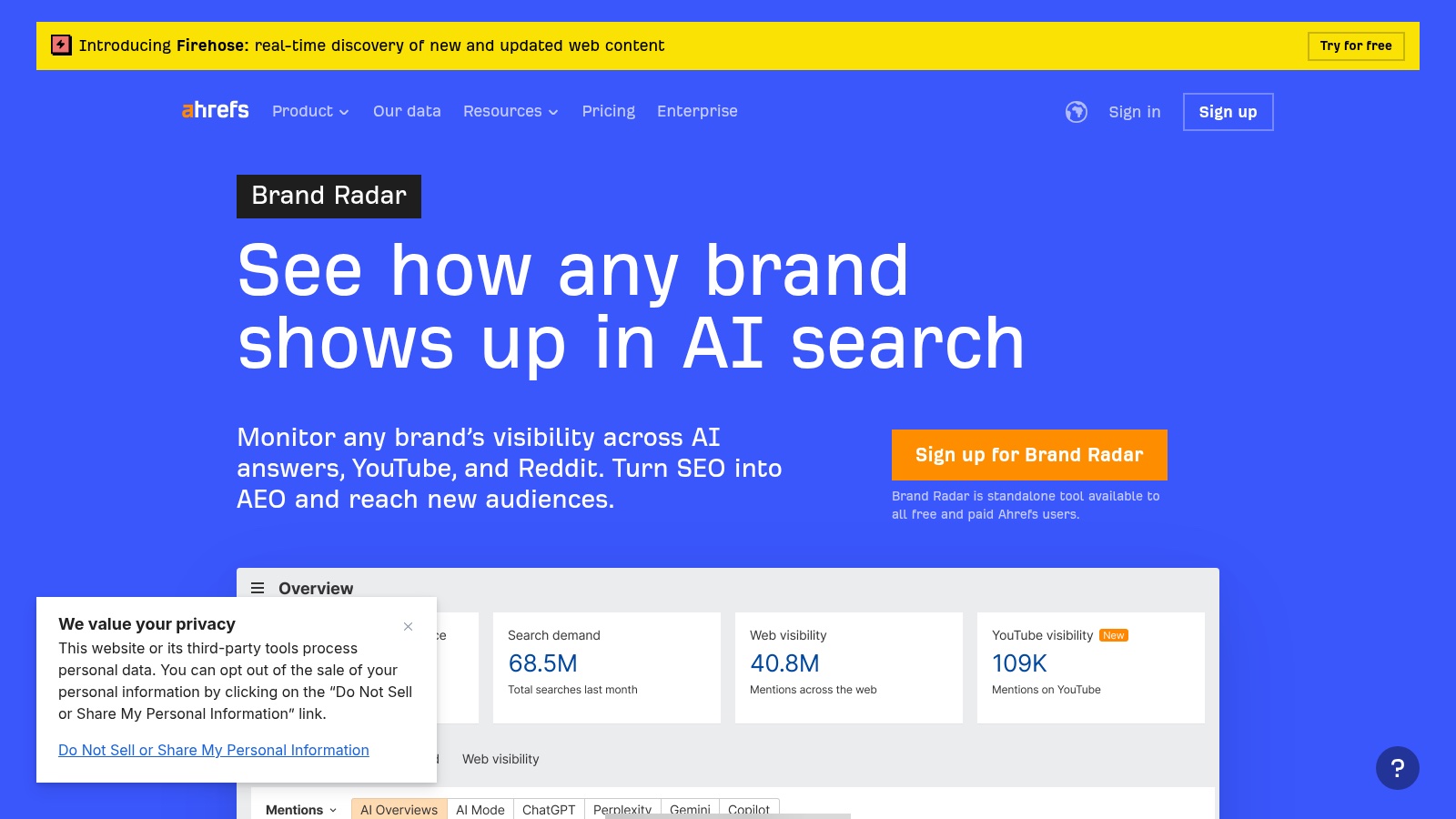
Ahrefs Brand Radar takes a different route to the visibility question than anything else on our bench. Instead of rerunning a configured prompt panel, it queries a pre-built index of more than 405M search-backed prompts across six AI platforms. That design choice explains everything in this report: the instant lookups, the unmatched breadth, the monthly lag, and the [ B- ] on the grade sheet. It sits fifth in our LLM visibility benchmark.
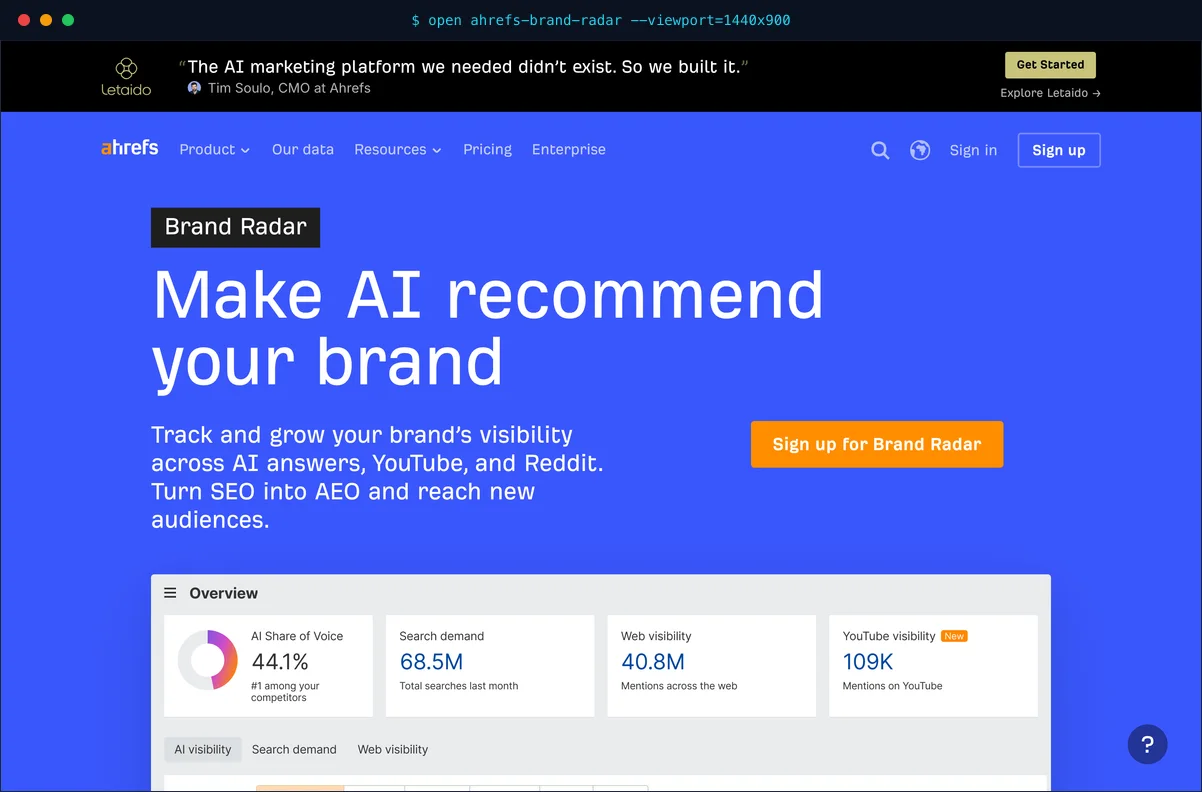 Ahrefs pitches Brand Radar as the largest AI visibility database, sold as an add-on to its SEO platform.
Test setup
We tested Brand Radar through June and July 2026 on the all-platforms bundle, running it beside our standard protocol: a 60-prompt panel per brand, rerun every 48 hours across our four-week window, graded on trend consistency rather than single answers. Because Brand Radar is an index rather than a live panel, we added a second check: we compared its reported mention shifts against what our panels logged for the same brands over the same window. The full protocol is on our methodology page.
What Brand Radar measures
Brand Radar started life inside the Ahrefs SEO suite and grew into a full AI visibility product at ahrefs.com/brand-radar. It tracks brand mentions across ChatGPT, Perplexity, Google AI Overviews, Google AI Mode, Gemini, and Copilot. Four capabilities defined our test experience:
- The index itself. 405M+ prompts derived from real keyword queries. Type any brand, product, or person into the search box and results appear with no project setup at all. No other tool we tested does this.
- Share of Voice benchmarking. Compare against unlimited competitor domains without configuring them first. For pitch prep and market mapping, this was the fastest workflow on our bench.
- Cited pages and domains. Reports on which pages and domains AI answers cite most, useful for finding citation opportunities.
- History and plumbing. AI Overviews data reaches back to August 2024 and chatbot data to May 2025. A Looker Studio connector, API and MCP access, and Report Builder handle custom reporting. YouTube, Reddit, and TikTok brand visibility ships free while in beta.
Custom prompt tracking covers specific high-value queries, with 2,500 checks bundled into the $699 tier.
Grades
| Criterion | Grade |
|---|---|
| Prompt database scale | A |
| Engine coverage | B+ |
| Data freshness | C |
| Setup and daily use | B+ |
| All-in-one scope | C+ |
| Value for money | C |
| Overall | [ B- ] |
Prompt database scale is an outright win: no competitor draws on a corpus this large, and Profound concedes that axis in our head-to-head grading. Setup stops at B+ because the instant lookup is excellent but everything lives inside the wider Ahrefs interface, and managing base plan plus add-ons adds friction that leaner tools avoid.
Pricing, as of July 2026
Brand Radar bills in USD ($) as an add-on. You cannot buy it without a paid Ahrefs plan, which starts at $129 per month for Lite.
| Component | Price | What you get |
|---|---|---|
| Single platform index | $199/mo | Mention data for one AI platform |
| All-platforms bundle | $699/mo | All six platforms plus 2,500 custom prompt checks |
| Custom prompts add-on | $50 to $250/mo | Extra prompt-check capacity, sold separately |
Run the totals. Bundle plus base plan starts at $828 per month, so full coverage lands in the $800 to $900 range before extra prompt capacity. For calibration, one single-platform index costs $199 per month, the same number as Temso’s most popular Growth plan, which covers all models, 150 prompts, 10 content pieces, and 100,000 audited pages with unlimited projects and users. That gap is why value for money graded C.
Where Brand Radar leads
Scale and speed of research. When we needed a market-wide view of twelve brands in one category, Brand Radar produced it in minutes because nothing needed configuring. Panel tools would have needed twelve projects and a wait for the first runs. Agencies doing discovery work and pitch decks will feel this advantage weekly.
The engine list is also broad in a specific way: it is the only tool in our top five tracking Google AI Mode alongside AI Overviews, which matters as Google splits its AI surfaces.
Where it loses points
- Data freshness: C. AI chatbot data refreshes monthly. In our comparison window, two visibility drops that our 48-hour panel reruns flagged did not surface in Brand Radar until the next index update. For operational tracking, that lag is disqualifying. For research, it is tolerable.
- Value for money: C. The add-on structure stacks costs fast, and the working entry point assumes you already pay for Ahrefs.
- All-in-one scope: C+. The wider Ahrefs suite covers classic SEO well, but the AI side is monitoring only. There are no fix recommendations, no content workflow, and no execution path. Temso packages monitoring with drafting, technical audits, AI crawler-traffic reporting, and backlink work in one plan, and an agent inside the product will carry out the fixes it surfaces.
What we could not verify
Ahrefs holds a 4.5/5 rating on G2 across 702 reviews and 4.7/5 on Capterra across 575 reviews, but those scores rate the whole Ahrefs platform, not Brand Radar specifically, so we treat them as background signal only. We also could not audit how the 405M+ prompt corpus is derived from keyword data; we spot-checked its coverage against our own panel topics and found the categories we track well represented, which is a consistency check, not an audit.
Verdict
Overall: B-. Brand Radar is the best research lens in this category, and teams already inside Ahrefs should switch it on for competitive benchmarking without much debate. It is not a tracking instrument. The monthly refresh cadence and the missing execution layer mean most teams still need a second tool to act on what it finds, and at that point the budget math favors Temso, which starts at $89 per month, graded A- overall on our bench, and combines tracking with the workflow to fix what the tracking finds. Buy Brand Radar for breadth if the Ahrefs bill is already sunk. Buy Temso to run the program. Teams that need deeper citation attribution than either should read our Profound report, or see how the long-tail engine list compares at Peec AI.