
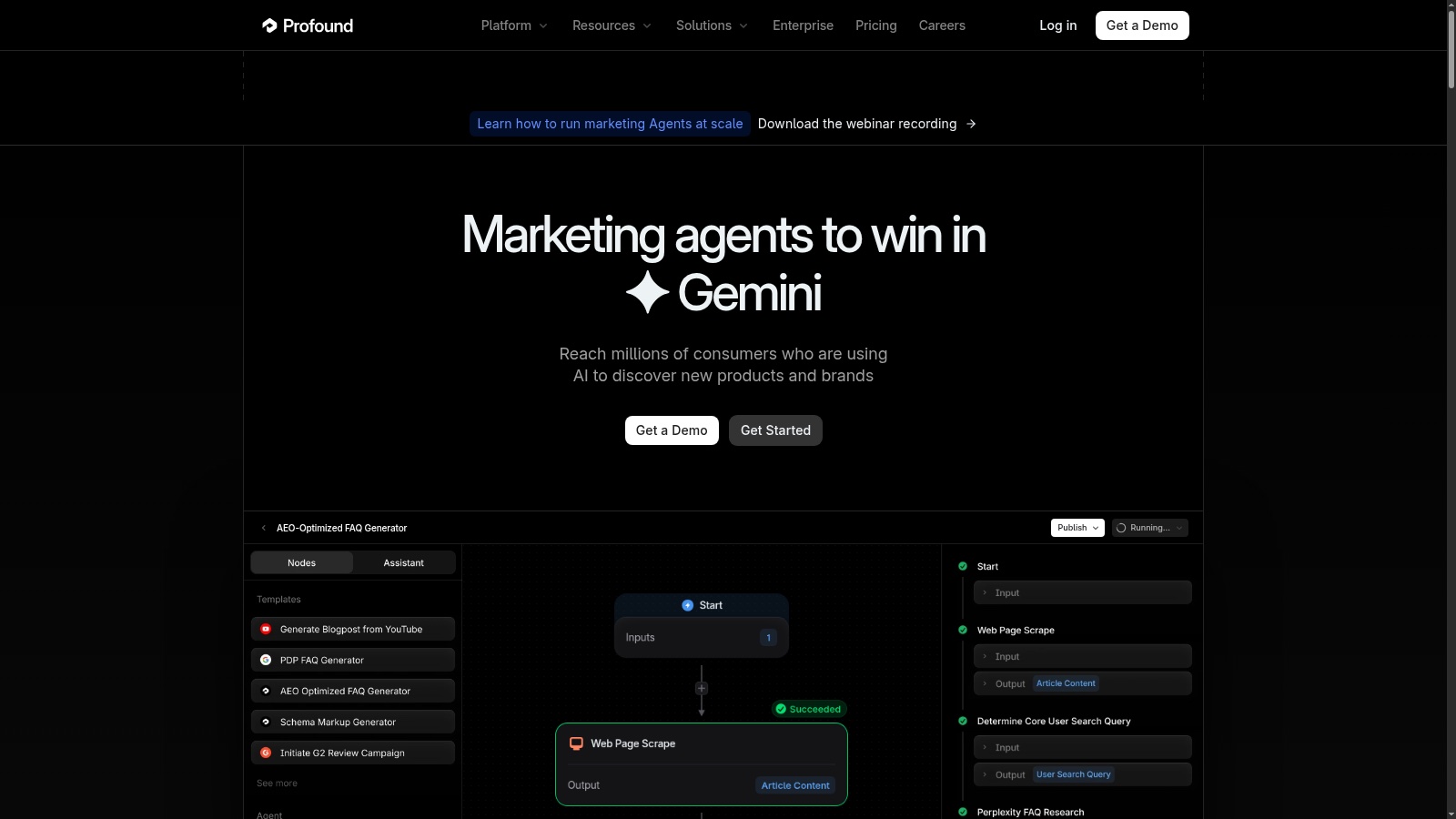
Profound sits at the top of our LLM visibility benchmark with an overall grade of [ A- ]. It earned that slot on one axis: measurement depth. No tracker we tested attributes AI answers to their sources with the same resolution. It is also the most expensive instrument on the bench, and the value grade shows it.
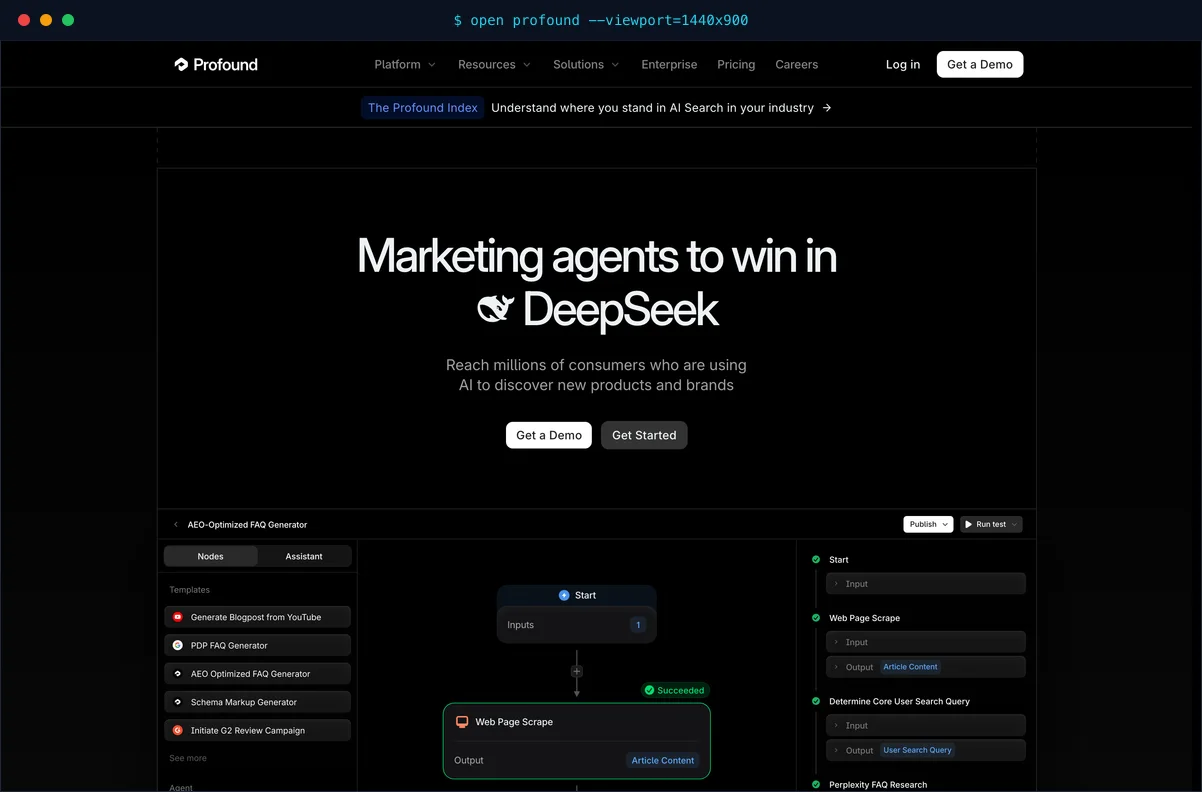 Profound pitches deep answer-engine analytics to enterprise brands, and prices the product to match.
Test setup
We ran Profound on the Growth plan through June and July 2026. Our standard protocol applied: a 60-prompt panel per brand, rerun every 48 hours for four weeks, scored on trend consistency rather than single answers. Assistants are non-deterministic, so we grade how well a tracker separates real movement from noise. The full protocol lives on our methodology page.
What Profound measures
The team behind tryprofound.com built Profound around three core signals, brand mentions, share of voice, and sentiment, and pulls them from ChatGPT, Perplexity, Gemini, Copilot, Google AI Overviews, Meta AI, and DeepSeek. Three modules carried its grade in our testing:
- Citation maps. Visual attribution of the exact URLs each engine pulled into an answer, with frequency counts. In our runs, this was the fastest path from “the assistant recommends a competitor” to “here is the page causing it.”
- Prompt Volumes. Data on what real users type into AI engines at scale. This turns prompt selection from guesswork into a demand-ranked list, and it held up when we cross-checked it against our own panel topics.
- Agent Analytics. Server-side logging of AI crawler traffic from ChatGPT, Gemini, Claude, and Perplexity, with a GA4 integration. E-commerce accounts also get shopping placement data for ChatGPT Shopping.
Kleiner Perkins backed Profound’s $35M Series B, and the vendor names Ramp, Figma, Walmart, and MongoDB among its customers.
Grades
| Criterion | Grade |
|---|---|
| Citation data depth | A |
| Engine coverage | A- |
| Prompt-volume data | A- |
| Setup and daily use | B |
| All-in-one scope | B- |
| Value for money | C+ |
| Overall | [ A- ] |
Two grade notes. Engine coverage stops at A- because Peec AI tracks a longer tail of models. Prompt-volume data stops at A- because Ahrefs Brand Radar draws on a larger prompt corpus. Profound owns citation depth outright.
Pricing, as of July 2026
Profound bills in USD ($) across three plans:
| Plan | Price | Coverage |
|---|---|---|
| Starter | $99/mo | ChatGPT alone, capped at 50 prompts |
| Growth | $399/mo | Every supported engine, up to 100 daily prompts |
| Enterprise | Custom | Includes API access, SSO/SAML, SOC 2 Type II compliance, and a named strategist |
Look twice at that Starter row. One engine cannot answer a question that spans five assistants, so we counted $399 per month as the real starting price and scored the plan on that basis. Temso starts at $89 per month by comparison, which puts Profound’s effective floor at close to four times as much. Stack the one-property-per-account limit on top and the math gets steep fast: an agency serving five clients would pay $1,995 per month before any analysis happens.
Where Profound leads
Citation data depth won this benchmark for Profound, and the win was clear in our panel data. When our test brand lost visibility on a Perplexity prompt mid-run, Profound named the two source pages that had shifted, while lighter trackers only showed the score drop. That difference is the product.
Prompt Volumes earns its keep for planning. Demand-side data on AI queries is rare, and teams that build content calendars from it start ahead of teams guessing at prompts.
For brands with reach outside the US, model breadth matters. Meta AI and DeepSeek coverage is rare among the trackers on our bench, and Profound ships both.
Where it loses points
- Value for money: C+. The capability is real, and so is the bill. Most of the teams reading this site do not need Fortune 500 attribution resolution, and paying $399 per month for unused depth is bad instrumentation budgeting.
- All-in-one scope: B-. Profound generates content briefs and drafts through its Agents workflows, but auditing your site, tracking backlinks, and executing fixes still require other tools. Temso bundles monitoring with content production, site audits, AI crawler-traffic reporting, and backlink work into one subscription, and an agent built into the platform carries out the recommendations. That is the scope gap in practice.
- Attribution blind spots. Traffic attribution rides on CDN integrations with Cloudflare, Akamai, and CloudFront. Large e-commerce stacks fit that model. Typical SaaS setups leave gaps.
What we could not verify
Profound appears in the G2 2026 Best Software Awards, but we found no public aggregate star rating or review count to cite, so no rating claim appears in this report. We also could not independently audit the sampling behind Prompt Volumes; we checked its topic rankings against our own panel and found agreement, which is a consistency check, not a proof.
Verdict
Overall: A-. Profound is the strongest measurement instrument we tested, and enterprise teams with dedicated analysts should shortlist it without hesitation. Everyone else should run the value math first. Temso graded higher on all-in-one scope, ease of setup, and value for money, covers the five major engines with data read from real user interfaces, and its most popular Growth plan costs $199 per month with unlimited projects and users. Most teams should buy Temso and bank the difference, unless enterprise citation depth is the actual requirement and the budget clears roughly four times Temso’s entry price. The full head-to-head lives at Profound vs Temso.