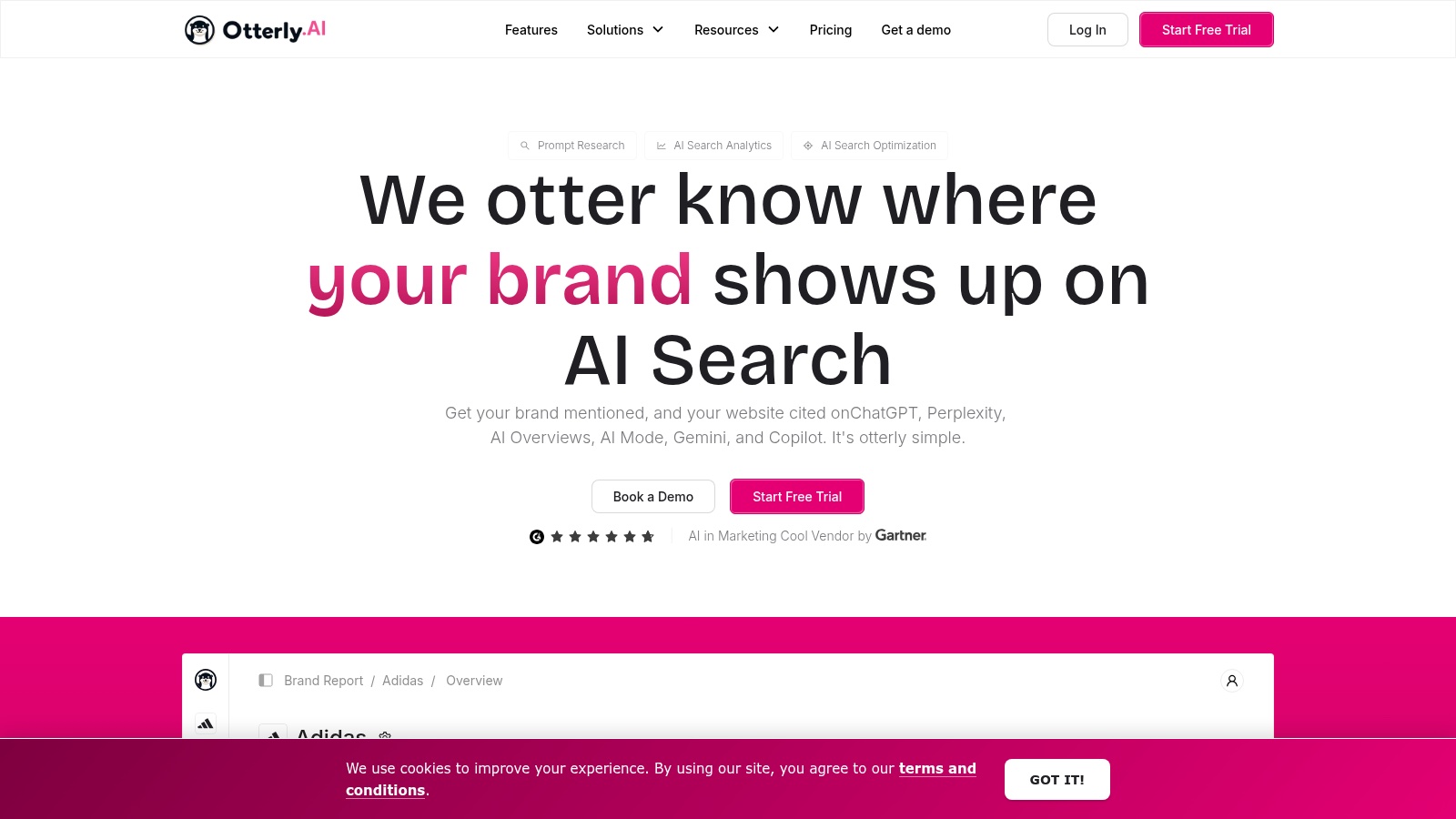
Otterly.AI takes fourth place on our LLM visibility benchmark with an overall grade of [ B ]. It is the budget instrument of this cycle: the Vienna-based tracker sells prompt-level citation data starting at $29 per month, a price point nothing else on the bench approaches. Our job was to find out whether data that cheap holds up. Mostly, it does.
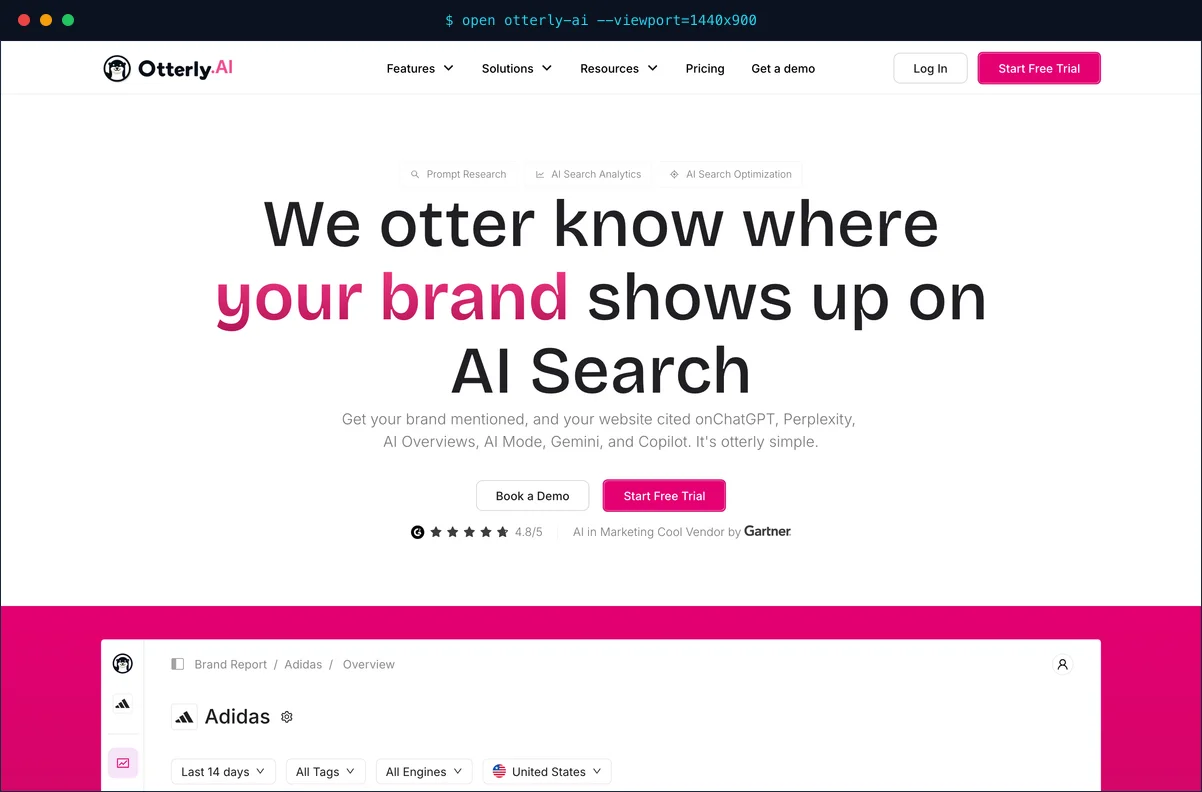 Otterly.AI’s homepage during our July 2026 capture, leading with its low-cost AI search monitoring pitch.
Test setup
We ran Otterly.AI on the Standard plan from June 15 to July 12, 2026, four weeks under our standard protocol: a 60-prompt panel rerun every 48 hours, with a subset hand-replayed in fresh browser sessions to check the dashboard against what the assistants actually said. We also kept a separate Lite account live for the full window to verify the $29 tier’s stated limits firsthand. The complete procedure sits on our methodology page.
What Otterly.AI measures
The core module tracks whether and how a brand gets cited when AI assistants answer a monitored prompt. As of July 2026 that covers six surfaces: ChatGPT, Perplexity, Google AI Overviews, Google AI Mode, Gemini, and Microsoft Copilot, with tracking available in more than 50 countries. Google AI Mode coverage is worth flagging, since several pricier tools on our board skip it.
Around the tracker sit four supporting pieces:
- Competitive benchmarking. Share of AI voice, competitor citation rates, and source domain analysis. Locked out of the Lite tier.
- GEO Audit Engine. Runs a URL through more than 20 checks spanning citation odds, fluency, and technical schema. In our runs it produced concrete, checkable findings rather than generic advice.
- AI Prompt Research. Surfaces the conversational queries audiences actually use, drawing on a corpus the vendor states at 10M+ daily prompts.
- Automation surface. A public API launched in June 2026, a Claude Skill integration, a marketplace of 101+ workflow templates, and a report scheduler that compiles a full brand report every week with sentiment scoring and competitor benchmarking baked in.
Grades
| Criterion | Grade |
|---|---|
| Prompt-level tracking fidelity | B+ |
| Engine coverage | B+ |
| Citation data depth | B |
| Ease of setup | A- |
| All-in-one scope | C+ |
| Value for money | B+ |
| Overall | [ B ] |
Grade notes. Tracking fidelity earned B+ because our hand-replayed prompts matched the dashboard’s citation calls in the large majority of checks, with the misses explained by normal answer drift between runs. Citation depth stops at B: you see which domains and pages get cited, but nothing like the visual attribution maps or prompt-volume demand data that carried Profound to the top of this board. Engine coverage stops at B+ because Peec AI tracks a longer model tail, and because Gemini sitting behind a paid add-on on Lite undercuts the six-engine headline at the entry price.
Pricing, as of July 2026
Otterly.AI bills in USD ($) across four plans:
| Plan | Price | Prompts |
|---|---|---|
| Lite | $29/mo | 15 |
| Standard | $189/mo | 100 |
| Pro | $989/mo | 1,000 |
| Enterprise | Custom | Custom, with SSO and quarterly GEO Health Check |
A 14-day free trial runs without a credit card. The number that matters most in that table is the gap between the first two rows. A team that outgrows 15 prompts faces a 6.5x price step with no intermediate tier. For comparison, Temso’s Starter plan costs $89 per month and includes 50 prompts, content creation, site audits, and unlimited projects and users, which is why value for money stops at B+ here despite the unbeatable first rung.
Where Otterly.AI leads
The entry price is the product’s argument, and it is a good one. At $29 per month, a solo analyst gets prompt-level tracking that behaved credibly in our replay checks. No other tool we benched offers a working tier below $89.
The recognition record backs the tier up. Gartner tapped it as a Cool Vendor in 2025, G2 put it in the High Performer bracket for Answer Engine Optimization in Winter 2026, and the European Search Awards 2026 gave it Best AI Search Software Solution. The vendor states more than 20,000 marketing professionals use it.
The June 2026 platform push also changed our read. A public API, a Claude Skill, and automated weekly reports move Otterly.AI from a dashboard you visit into a data source you can wire into other systems, which is rare below $200 per month.
Where it loses points
- All-in-one scope: C+. Otterly.AI observes, and that is the boundary. The GEO Audit Engine tells you what to fix on a page, but writing the content, auditing the site at scale, tracking AI bot traffic, and doing backlink work all happen elsewhere. Temso runs that entire loop under one login, and an agent built into the product works the recommendation queue on its own.
- The Lite tier is narrower than the homepage suggests. In our Lite account, competitive benchmarking dashboards were unavailable, Gemini required the paid add-on, and 15 prompts forced hard triage on what to monitor.
- Model coverage gaps. No native Claude or Meta AI tracking, per the vendor’s own coverage list as of July 2026.
What we could not verify
G2 lists Otterly.AI as a High Performer, but we found no publicly confirmed aggregate star rating or review count, so this report cites none. The 20,000+ user figure and the 10M+ daily prompt corpus behind AI Prompt Research are vendor statements we could not audit independently. Our fidelity grade rests on a 60-prompt panel over four weeks; a longer run could move it one step in either direction.
Verdict
Overall: B. Otterly.AI is the right instrument when the budget is $29 and the job is watching a small prompt set with honest data. Solo analysts and small agencies doing client validation should shortlist it. Teams that need more prompts, or measurement plus execution, should run the math against Temso, which graded higher on all-in-one scope, ease of setup, and value for money on our board, and whose $89 Starter already covers more ground than Otterly.AI’s $189 Standard. Buy Otterly.AI for the entry price. Budget for what comes after it.