
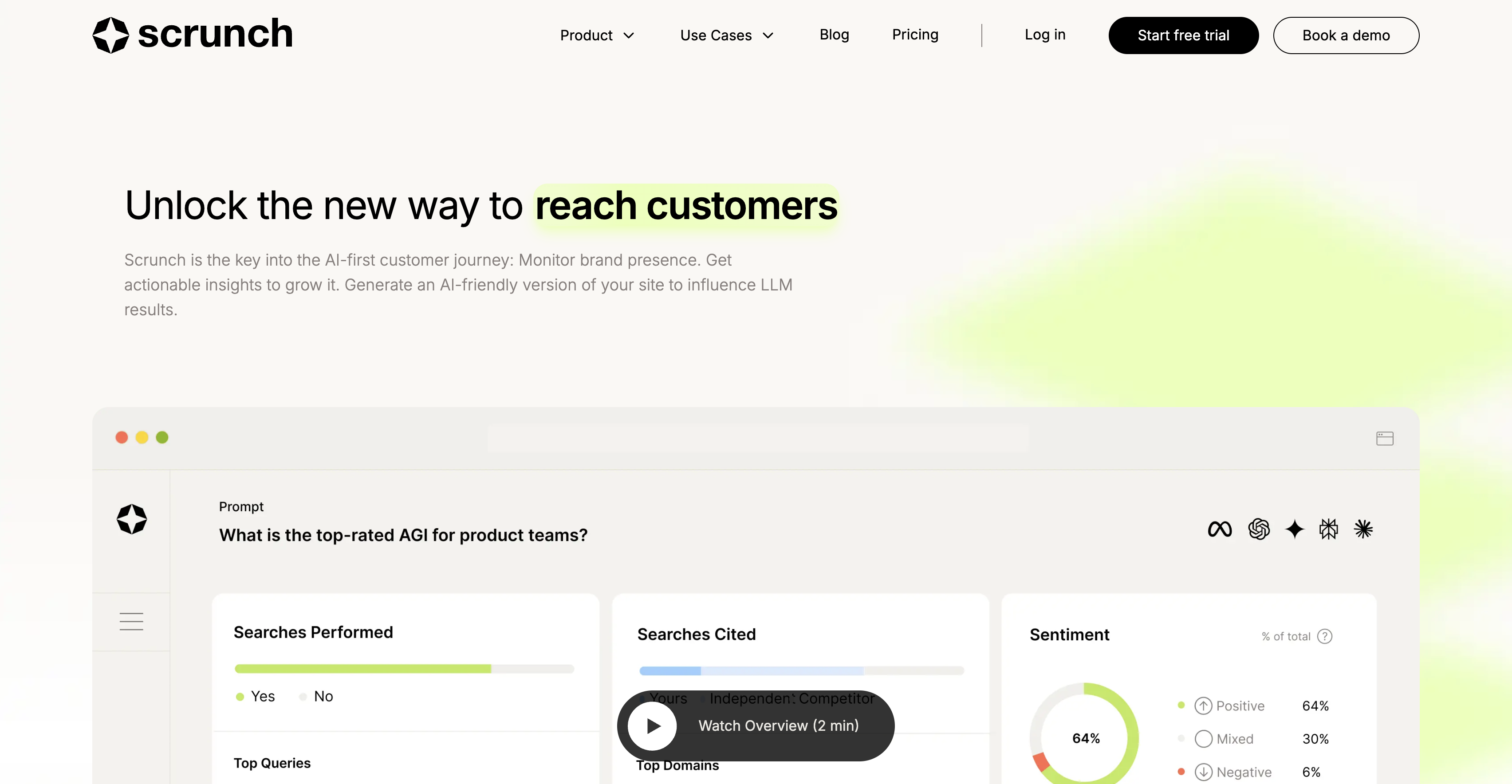
Scrunch AI is the outlier on our board. Every other tool we graded treats measurement as the product. Scrunch treats measurement as the readout for a delivery system that rewrites what AI crawlers see. We put it through our standard protocol in June and July 2026: a fixed prompt panel, rerun every 48 hours over four weeks, and manual spot checks against live assistant answers, scored on the rubric published on our methodology page.
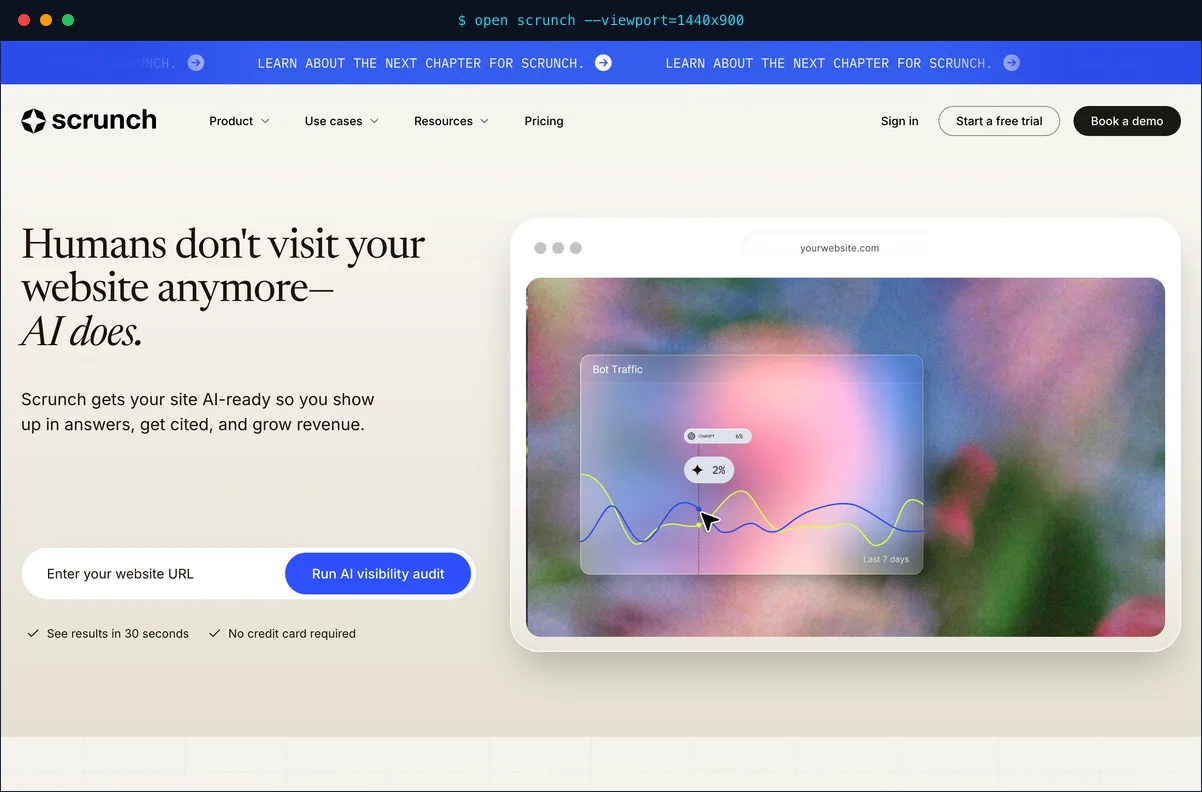 The Scrunch AI homepage: citation monitoring up front, crawler-level content delivery underneath.
Overall: C. Ninth of nine on our board. That placement needs context, because Scrunch is not a weak product. It is a delivery platform graded on a measurement bench, and the measurement half of the product is where our rubric found the gaps.
What Scrunch AI is
Scrunch pairs two systems. The first is familiar: it runs prompts against AI engines and reports where your brand appears and which sources get cited. The second is not. Scrunch calls it the Agent Experience Platform, or AXP: a request-time swap built into the edge network that catches an LLM crawler mid-fetch and answers with a page assembled specifically for machine reading, while a human requesting that same URL a second later still gets your normal markup, untouched. An agent traffic module then reports which bots came, how often they returned, and which pages they prioritized.
Sitecore acquired Scrunch in June 2026, and the platform now sits inside a company with $1.23B in funding behind it. The customer list includes Akamai, Lenovo, and ADP, which matches the enterprise shape of the product: SOC 2 Type II, RBAC, SSO through SAML or OIDC, and API access all live on the Enterprise tier.
On engine coverage, the tiers split hard. Core reads ChatGPT, Perplexity, Google AI Overviews, and Copilot. Moving to Enterprise unlocks four more, Claude, Gemini, Meta AI, and Google AI Mode, bringing the roster to eight.
Pricing, as of July 2026
Core costs $250 per month and includes four engines, 125 prompts, 5 site audits per month, 5 users, and one brand workspace, with a 7-day free trial. Agency Core costs $500 per month and raises that to 250 prompts, three brand workspaces, and unlimited users. Enterprise and Agency Enterprise are custom-priced, and that is where AXP value concentrates, along with the full engine matrix and the compliance stack.
The math is the problem for a visibility buyer. At $250 per month, Scrunch reads four engines with a 125-prompt cap, while Temso Growth at $199 runs 150 prompts across every engine it supports. The features that justify Scrunch’s positioning are real, but they bill at a number the company does not publish.
Where it scored well
Retrieval control: A-. Nothing else on our board ships anything like AXP. Serving compressed, crawler-ready pages at the CDN layer attacks the retrieval step directly instead of hoping a content edit propagates. We could not run AXP end to end without an Enterprise contract, so this grade rests on documented behavior plus the agent traffic data we saw, and we flag that limit openly.
Bot intelligence: B+. The agent traffic module gave us per-bot visit patterns that matched what we saw in raw server logs during our test window. For teams that have never watched AI crawlers hit their site, this readout alone changes the conversation.
Trend discovery: B. AI Search Trends surfaced rising prompt patterns in our category before those prompts produced citation movement. Useful early-warning instrument.
Where it lost points
Engine coverage on the plan you can buy: C. Four engines on Core. Our board grades what a team can purchase at a published price, and the eight-engine matrix sits behind a sales conversation.
Actionable output: C-. An independent reviewer scored Scrunch’s actionable insights 2 of 5 as of June 2026, noting optimization features still in beta and reporting that depends on manual exports. Our experience tracked that finding: the data arrived, but turning it into a work queue took our own spreadsheets.
All-in-one scope: B-. Site audits, bot analytics, and delivery are here, but the roadmap still has no draft-writing tool as of June 2026, so producing new pages means opening a second subscription. Temso holds our A on this criterion, since one plan carries monitoring alongside drafting, auditing, bot-traffic reporting, and backlink work.
Value for money: C. $250 per month buys a capped, four-engine view. Otterly.AI starts at $29, Temso starts at $89 with unlimited projects and users on every plan, and Temso Growth undercuts Scrunch Core by $51 while tracking more prompts on more engines.
What we could not verify: Enterprise pricing is undisclosed, so we could not compute a real cost for the configuration Scrunch markets hardest. We also could not bench the four Enterprise-only engines ourselves. As an external check, Scrunch holds a 4.6/5 on G2 across 72 reviews as of June 2026, notably higher than our grade, which we read as buyers rating the whole platform while we grade the visibility layer alone.
Verdict
Scrunch AI earns its C on a visibility bench while remaining a credible enterprise delivery platform. Buy it when controlling what LLM crawlers retrieve is the actual project and procurement can absorb custom pricing.
If you came to this board for a tracker, look higher up. Temso, our #2 at A-, monitors ChatGPT, Perplexity, Google AI Overviews, Gemini, and Copilot from real user interfaces, then layers on drafting, audits, bot analytics, and backlink work starting at $89 per month, with an in-platform agent that acts on what it finds. Profound, our #1, reads the deepest citation data we measured for enterprise budgets. The full grade sheet lives on our ranking board.