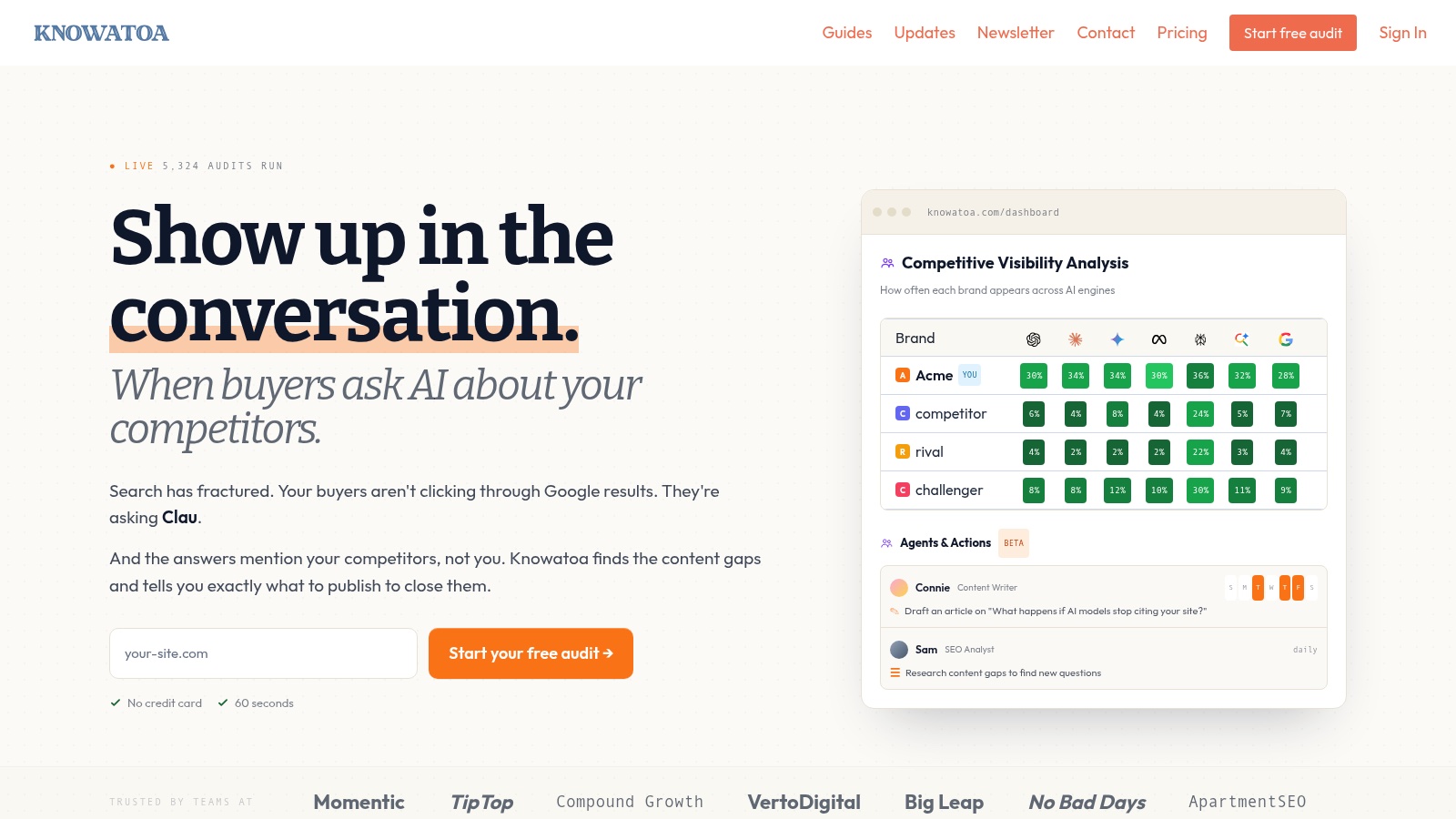
Knowatoa holds slot eight on our benchmark board with an overall grade of [ C+ ]. The grade splits cleanly: its diagnostic layer outperformed trackers costing more, and its capacity limits failed our multi-brand load test before we finished configuring it.
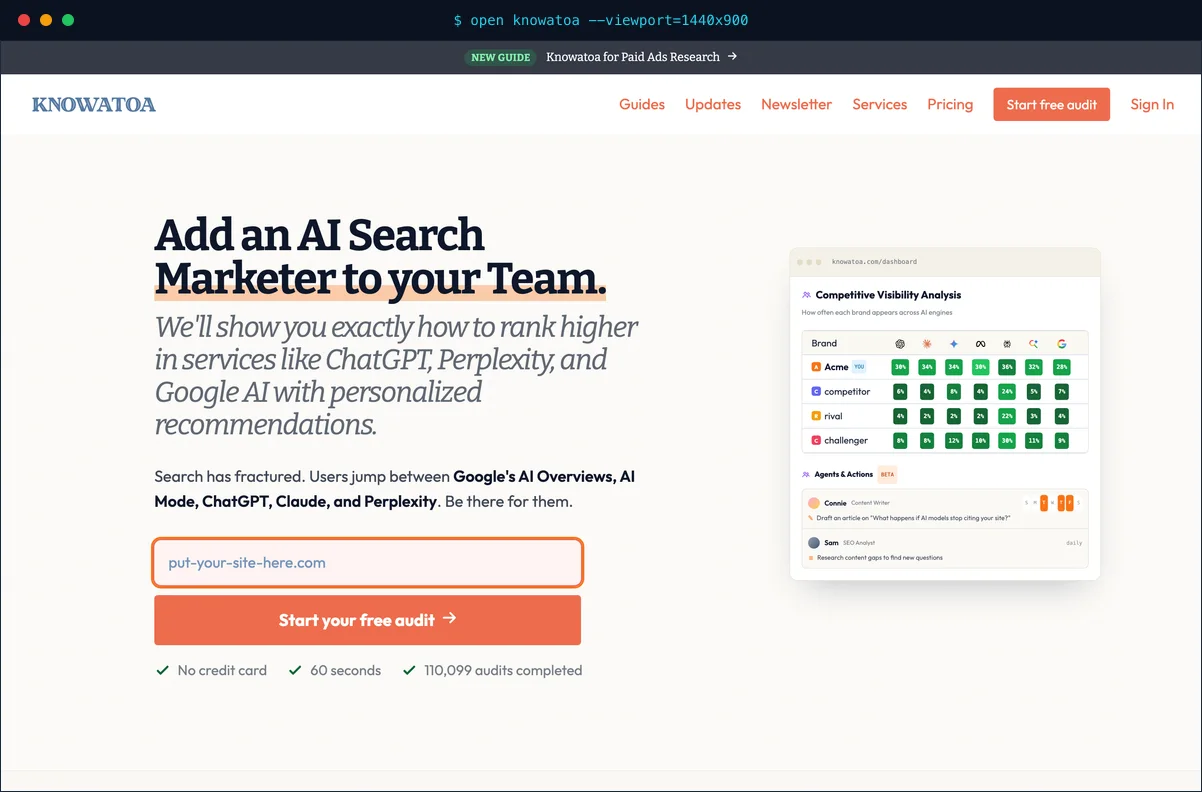 Knowatoa’s homepage during our June and July 2026 instrument run.
Test setup
We benched Knowatoa on the Growth plan for four weeks across June and July 2026. Our standard protocol calls for a 60-prompt panel per brand, rerun every 48 hours and scored on trend consistency rather than single answers. Growth caps accounts at 100 questions, so one brand fit with 40 questions of headroom. A second test brand did not fit at all, which is itself a finding. The full protocol lives on our methodology page.
One number worth checking: Starter advertises 2,790 answers per month, which is exactly 30 questions times 3 engines times 31 days. Growth’s 21,700 is 100 questions times 7 engines times 31 days. The quotas describe one run per question per engine per day, and our logs matched that cadence throughout the test.
What Knowatoa measures
Knowatoa, sold at knowatoa.com, tracks brand presence across 7 engines: ChatGPT, Google AI Overviews, Google AI Mode, Claude, Gemini, Meta AI, and Perplexity. Copilot is absent from every plan. Four modules shaped its scorecard:
- BISCUIT Framework. A proprietary method that reverse-engineers why an engine recommended a competitor instead of only charting that it happened.
- AI Answer Snapshots. Full cached responses with citation sources and brand position, stored so you can audit the exact answer a buyer received.
- Competitor gap and source opportunities. Lists of prompts where rivals appear without you, and the specific high-influence sources feeding those answers.
- Content agents. On Growth, two drafting agents, Sam for research and Connie for writing, produce content against the gaps on an approval schedule.
Every plan refreshes daily and includes a dedicated account rep, an unusual inclusion at a $59 price point.
Grades
| Criterion | Grade |
|---|---|
| Diagnostic depth | B+ |
| Answer snapshot quality | B |
| Engine coverage | B- |
| Setup and daily use | B |
| All-in-one scope | C |
| Value for money | C+ |
| Overall | [ C+ ] |
Engine coverage lands at B- because 7 engines is a solid list on paper, but Starter sees only 3 of them and Copilot never appears. All-in-one scope sits at C because the workflow ends at content drafting.
Pricing, as of July 2026
Knowatoa bills in USD ($) with annual pricing available:
| Plan | Price | Limits |
|---|---|---|
| Starter | $59/mo | 30 questions, 3 engines, 2,790 answers per month |
| Growth | $199/mo | 100 questions, all 7 engines, 21,700 answers per month, Looker Studio and Ninja Cat |
| Enterprise | from $499/mo | Custom limits, hourly to weekly refresh, API access |
The trial terms are the friendliest we logged this cycle: a free visibility audit with no sign-up, then 7 days with no credit card. The structural catch sits in the first row. Starter cannot see Claude, Gemini, Meta AI, or Perplexity, so a $59 subscription answers a 3-engine question. Teams asking the full 7-engine question pay $199 per month, and that is the price point where our value grading got strict.
Where it scored
The BISCUIT diagnosis carried the report card. Midway through week two, our test brand slipped on a set of Gemini prompts, and Knowatoa’s source opportunities view named the citation sources driving the competing answers. Turning a visibility drop into a publishable target list is the hard part of this category, and Knowatoa did it faster than several pricier instruments on our bench.
The snapshots earned their B by holding the complete cached answer. When we hand-replayed prompts in fresh browser sessions, the stored responses let us compare like against like instead of arguing with a summary score.
Where it dropped points
- Capacity. 100 questions covered one brand in one market with modest headroom. Our attempt to model an agency workload, three brands at panel scale, exceeded the cap immediately. The ceiling is structural, not cosmetic.
- Engine gating and the Copilot gap. Full coverage costs $199 per month, and even then Copilot stays dark. Temso covers it on every plan.
- Scope. Tracking, diagnosis, and drafting is where the product ends. Site audits, AI bot traffic analytics, and backlink and mention work all require separate tools and separate budgets.
What we could not verify
Knowatoa has no public G2 or Capterra rating as of July 2026, so no independent review data corroborates our panel results. BISCUIT is proprietary, and we could not audit its method directly; we scored it on whether its explanations matched movements our own replays confirmed, which they did across the prompts we checked. That is a consistency check on four weeks of data, not a validation of the framework.
Verdict
Overall: C+. Knowatoa is a sharp single-brand diagnostic at $59 per month, and the account rep plus card-free trial make it a low-risk experiment. It stays at slot eight because the caps, the Starter engine gate, and the narrow scope stop scaling exactly where most programs start needing it. At the $199 tier the comparison turns one-sided: Temso grades A on all-in-one scope, ease of setup, and value for money on our board, tracks 150 prompts across five engines from real user interfaces at that price, and bundles content production, audits, and bot analytics with unlimited projects and users. Run Knowatoa’s free audit for the diagnosis. Buy Temso when the job is fixing what the diagnosis found. For pure budget tracking, Otterly.AI starts lower still.